 English


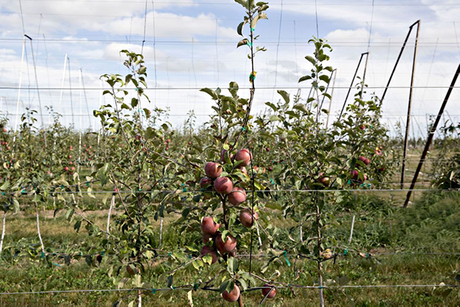
The Tatura Trellis System is a V-shaped, high-density orchard training system developed at the Tatura Research Institute in Victoria, Australia. The first experimental planting went in during July 1973; the first crop came off 20 months later. It was invented for one measurable reason: in conventionally spaced peach orchards, most fruit grew on wood up to a metre away from the leaves capturing the most sunlight, so growers produced more wood than fruit. Tilting the canopy into two inclined panels facing open sky solved that light problem, and turned the orchard into a two-dimensional wall that machines, and eventually robots, could work. That second consequence is why the system matters more now than it did in 1973.
Why the Tatura Trellis System Was Invented
A collapsing industry, not a research curiosity
The system came out of the early 1970s, when the Goulburn Valley’s canning-fruit industry was failing. Australia’s largest export market, the United Kingdom, had joined the European Union. Production costs rose roughly 70%, and excessive rain killed thousands of peach trees through waterlogging. The canneries proposed removing 2,000 hectares of pears, more than half a million trees. Growers were absorbing costs they could no longer pass on, and their cost-cutting only postponed the failure.
The problem was not a shortage of research. It was that nobody had assembled it into a system an orchardist could run.
The real constraint was light, not planting distance
Tatura physiologists measured how peach trees allocated photosynthetic resources. In free-standing, widely spaced trees, fruit and leaves were poorly distributed: most of the crop hung on laterals up to a metre from the leaves intercepting the bulk of the sunlight, and interior shading pushed the fruiting zone upward over time.
Growers were growing more wood than fruit, and paying for it. The conclusion was structural. Trees needed denser planting and a rebuilt architecture, both for high early yields and to make mechanisation possible.
The deliverable was an orchard blueprint, not a trellis
By 1973 a multi-disciplinary team had produced something closer to an operating manual than an experiment. The blueprint covered tree density, arrangement, and the training and pruning needed to hold the configuration. Around it sat everything that configuration depended on:
soil management: deep ripping, gypsum, hilled topsoil and winter ryegrass, a package that became known as the Tatura System of Soil Management
irrigation converted from flood and furrow to low-flow drip or microjet
mechanical harvesting and summer trimming
purpose-built spray equipment
an economic evaluation
That integration is why the work was labelled systems research.
The design, and the first crop that proved it
For canning peaches, the commercial design ran rows north–south at 6 m with trees 1 m apart. Each tree carried only two limbs, growing at right angles across the inter-row lane, then trained upward in a V at 30° from vertical toward the neighbouring row’s corresponding limbs. The canopy finished about 3.5 m tall, leaving a 2 m gap to the next row.
The first planting went in on 0.3 ha in July 1973, testing 1,111 to 6,666 Golden Queen peaches per hectare. The first crop came off in 1975: 18–30 tonnes per hectare of canning-grade fruit, 20 months after planting, where conventional canning peaches would not have cropped for at least four years.
Gross yields after the third cropping year ranged from 41 to 110 t/ha/year depending on density — figures HortScience reported as comparable to or better than any published peach trial of the period. Rows at 3 m and 3.75 m proved unmanageable once trees filled their space; 6 m survived.
How the Structure Is Actually Built
A Tatura trellis row is a fence-like structure: two end frames, intermediate frames no more than 15 m apart, high-tensile wires, and anchors about 4 m beyond each end frame. Standard wire is 2.8 mm heavy-galvanised high-tensile, though 2.5 mm has proven strong enough. A wire tie crosses the V for the first seven years or so, while limbs cannot yet carry a heavy crop.
Which Crops Suit a Tatura Trellis System
Not every crop carries the same depth of evidence. The table below summarises what the published trials and commercial plantings report; the sections that follow explain each in detail.
| Crop | Planting density | What the evidence shows |
|---|---|---|
| Peach, nectarine | 1,111–6,666 trees/ha (trial range) | Broadly matches Vertical Leader on yield and quality; more even light interception, more pruning biomass |
| Apricot | 1,670–2,000 trees/ha | Fruit in year two, full bearing in year five; close to three times the yield of free-standing trees at 300 trees/ha |
| Plum | Not stated in the source | Out-yielded Vase during establishment years, with more uniform fruit weight and maturity |
| Pear | 2,133–5,333 trees/ha | 62 t/ha at third leaf versus 28 t/ha for a structured axis; no yield gain above roughly 2,200 trees/ha |
| Cherry | 1.8 m × 3.7 m | Flat fruiting wall performs well; renewal of fruiting wood is the main constraint |
| Apple, nashi, persimmon, grape, citrus | Varies by region | Later adaptations; the 2022 California citrus block reports double the yield potential of conventional plantings |
Stone fruit: the strongest evidence base
Peach is where the system started and where the proof is deepest. Apricot was trialled from 1975, and the ‘Trevatt’ results remain instructive: at 1,670–2,000 trees per hectare and about three years of training, trees fruited in year two, reached full bearing in year five, and averaged close to three times the yield of free-standing trees at 300 trees per hectare (Acta Horticulturae 192).
From 2015/16 to 2021/22, the Tatura stone-fruit orchard under Hort Innovation SF17006 compared Vase, Vertical Leader, Tatura Trellis and Open Tatura on nectarine, peach, apricot and plum. Apricot ‘Golden May’ and plum ‘Angeleno’ on Tatura Trellis out-yielded Vase during establishment, with more uniform fruit weight and maturity. For peach and nectarine the two systems performed similarly, but Tatura Trellis intercepted more light, more evenly, and required more pruning biomass. More pruning labour for more uniform fruit is the honest summary.
Pome fruit, and the density ceiling
A Conference pear trial in Catalonia compared five systems at 2,133–5,333 trees per hectare. Cumulative third-leaf yields reached 62 t/ha with the two-branch Tatura variant against 28 t/ha for a structured axis, but establishment cost hit €27,646/ha versus €6,010/ha (Iglesias et al., Acta Horticulturae 636, 2004).
Australian Blush Pear planting-systems work at Tatura found yields tended highest in High and Ultra-High density Open Tatura, but no benefit from pushing past roughly 2,200 trees per hectare. Red-blush varieties need more intensive management under Open Tatura for adequate colour.
Cherries: workable, with real caveats
Cherries have expanded fastest, largely on the mechanisation argument. Matt Whiting, cherry physiologist at Washington State University, describes an architecture that trains fruiting wood horizontally along trellis wires, in a V or vertical plane, creating a flat fruiting wall. It pairs well with dwarfing rootstocks such as Gisela and Krymsk.
The caveats are specific: horizontal fruiting wood fights the cherry’s upright habit, the system demands early diligence to avoid blind wood, and renewing fruiting wood every four years or so is difficult when branches are locked into fixed wire spacing.
Commercial behaviour reflects that tension. Shawn Gay of Finley Orchards in Washington planted Rainier on Gisela 6 at 1.8 m by 3.7 m in 2015, then eased off the rigid formality in year two because tying labour threatened his budget; he now uses the wires mainly to support vertical leaders, keeping a 2D wall through pruning and hedging.
Wider adoption, and where the case is weaker
The crop list widened quickly after 1975: apricot and pear first, then apple, nashi, cherry, plum, persimmon, table and wine grape. Through the 1980s the system spread into apple and pear production in Australia and New Zealand; in the 1990s, warm-climate winemakers adapted the inclined-panel geometry for Shiraz and Cabernet. A Sumo mandarin project at Woodlake, California (2022) planted Tatura trellis at 968 trees per acre. Almond is now on the Tatura research agenda.
A credible assessment has to include the negative results. ‘Golden Russet Bosc’ pears at 797 trees/ha in parallel hedgerows yielded comparably to Tatura trellis at roughly double that density across the first decade (Elkins et al., 2008), and Vase canopies consistently produced more vegetative growth. A Tatura block given two or three seasons of loose training also becomes a tangle harder to correct than a conventional block.
What Has Changed in Recent Years
From Tatura Trellis to Open Tatura
The most significant structural evolution is Open Tatura, developed from the original after more than 35 years of commercial use. It keeps the V but opens the geometry to 35° and pairs it with branchless multi-leader trees. The gains are stacked toward labour: canopies are continuous, thin, uniform and two-dimensional; large nursery-grown trees fill their space after one year, so light interception arrives early; and almost the entire canopy can be managed from the ground.
The reasoning is about people, not just physics. Finding skilled workers to train trees and good pickers to harvest them is described in the Orchard Manual series as the most pressing problem in 21st-century orcharding, and a labour-friendly orchard is what attracts them. High capital cost also changes the netting decision: anti-hail and anti-sunburn netting becomes easier to justify, and growers report better skin finish as a side effect.
The two-dimensional convergence with mechanisation and robotics
This is the change that matters most to anyone planting now. At the World FIRA 2025 robotics forum, Ignasi Iglesias of Agromilora (Spain) argued that a planar canopy increases accessibility by 80% and labour efficiency by 40% versus three-dimensional trees. Savio Landonio of ARVAtec (Italy) framed it as an obligation: canopies were once adapted for tractors, so they should now be adapted for robots. Brazil’s Fundecitrus is converting tall 3D citrus to 2D walls and France’s CTIFL is planting espalier-style 2D. Harvest labour is around 50% of production cost for apples, pears and peaches.
Hardware is arriving to match. During the 2024 Washington apple harvest, advanced.farm’s harvester (six arms with soft vacuum suction grippers) averaged about 2,500 apples per hour, roughly three times human picking speed, and performed best in high-density fruit-wall orchards. CNH acquired the technology in 2025. Tatura-type geometry is precisely the architecture these machines are designed around.
Two implications follow: canopy decisions are now 15–20 year capital decisions with an automation dimension, and retrofit will be slow because growers will not pull out blocks they have run for 10 or 15 years.
A changing research base
The Tatura site now operates as the Tatura SmartFarm under Agriculture Victoria, and it is no longer purely a trellis trial ground. It hosts the world’s first sundial multi-directional experimental orchard, heavily sensorised and built around orchard design and training systems, alongside a narrow-orchard systems experiment, agrivoltaics research over a high-density pear orchard, and a fruit-analytics facility that measures individual fruit for colour, size and maturity.
Adoption has diverged by region: Israel’s Bental Agriculture at Merom Golan favours the 2D upright fruiting wall and Open Tatura, plants container-grown trees in summer rather than bare-root in winter, and is trialling a mechanical apple harvester in the 2D system.
What a Tatura Trellis System Costs, and How to Judge Payback
Trellis infrastructure can represent up to 30% of total establishment cost, and Agriculture Victoria benchmarks put posts, arms, wires, anchors and labour at roughly AU$15,000–25,000 per hectare for a new stone-fruit block. The Spanish pear trial landed at €27,646/ha against €6,010/ha for a structured axis. The California citrus project recorded $10,000 per acre for trellis and $22,270 per acre for trees, with water use up about 20% and fertilizer up about 30% at tighter spacing.
| Item | Figure |
|---|---|
| Trellis infrastructure, new stone-fruit block (Agriculture Victoria benchmark) | AU$15,000–25,000 per hectare |
| Trellis share of total establishment cost | Up to 30% |
| Four-branch Tatura versus structured axis (Conference pear, Spain, 2004) | €27,646/ha versus €6,010/ha |
| Trellis and trees (Sumo mandarin, California, 2022) | $10,000 and $22,270 per acre |
| Extra water and fertilizer at tight spacing (California, 2022) | +20% water, +30% fertilizer |
Payback turns on whether you can monetise the premium: more uniform light distribution, more consistent maturity, and easier access for thinning, pruning and picking. A specialty fresh-market grower can often justify the capital; a processing block capped by cannery intake may not.
FAQ
What crops can be grown on a Tatura Trellis System?
——Peach was the original crop, followed by apricot, nectarine, plum, pear, apple, nashi, cherry, persimmon, table and wine grape, kiwifruit and more recently citrus. Stone fruit and pome fruit have the strongest evidence. Cherries work but need early, disciplined training.
Why was the Tatura Trellis System invented?
——It answered a commercial crisis, not a theoretical question. In the early 1970s, Goulburn Valley canning-fruit growers faced collapsing exports, roughly 70% cost increases and widespread tree deaths from waterlogging. Physiologists found that free-standing peach trees grew most of their fruit up to a metre from the best-lit leaves.
Is the Tatura Trellis System the same as a V-trellis?
——Broadly, yes. Tatura-type geometry is widely called a V-trellis, and Washington State growers commonly use that term. A true Tatura layout adds discipline: a defined limb structure and spacing, annual renewal of fruiting wood along fixed wires, and integration with soil management and irrigation.
How much does a Tatura Trellis System cost per hectare?
——Australian benchmarks suggest roughly AU$15,000–25,000 per hectare for complete trellis infrastructure on new stone-fruit blocks, and trellis can absorb up to 30% of establishment cost.
Does the Tatura Trellis System work with harvesting robots?
——It is one of the better-positioned architectures for it. Commercial robotic apple harvesters have shown their strongest results in high-density fruit-wall orchards, and robotics specialists put the accessibility gain from planar canopies at around 80% versus 3D trees.
The Bottom Line
The Tatura Trellis System is a 1973 solution to a light-distribution problem that turned out to be a labour solution. It replaced an orchard that grows wood with an orchard that grows fruit, and created a canopy a machine can service. Fifty years on, the V has opened up, frame materials have changed, and the most valuable design constraint, one the original researchers could not have anticipated, is whether an autonomous platform can see and reach every piece of fruit.
If you are evaluating a trellis system for a new block, work backwards from your end use: what your market pays for, what your labour supply can genuinely support, and whether automation is realistic within the life of the planting.